Your Local Insight News
Welcome to our Spring Insight update!

Your local Insight News brings you a snapshot of health and wellbeing Insights reflecting feedback abouts people’s experiences of living in Medway and Swale. We hope these Insights can inform your work to improve services for residents of Medway and Swale.  

 What we have heard about:

Online healthcare / Primary care / Mental health / Community health & prevention / Social care / Building a Neighbourhood Health approach / Wider determinants of health / Community and system news


Online healthcare

Clear split in the public’s feelings about online appointments

In January in a quick public survey, we asked if individuals would prefer an online appointment with a shorter wait time, or an in-person appointment with a longer wait time.

There was an equal split in opinion, with 4 in 10 saying they would prefer online appointment with a shorter wait, and conversely 4 in 10 people saying they would prefer to wait longer for a face-to-face appointment. 2 in 10 people had no preference.


Join our Voices Connect panel
Levels of negative feedback about eConsult are highest in Medway 

Levels of negative feedback about eConsult are increasing and our data suggests that they are highest in working age adults 35 years to 65 years. Experiences of eConsult are reported as more positive in the under 35 years age groups. 

Our data also suggests that a disproportionately higher volume of people are reporting negative experiences in Medway, with mapping indicating that this aligns LSOAs in the 10% most deprived in England. 

Read the full report
 

Primary care

ADHD Hidden Waiting lists 

The experiences of Medway and Swale residents living with ADHD or a loved one living with ADHD, contributed to a Kent and Medway wide Healthwatch ADHD review. The report found that a disproportionate amount of negative feedback came from Medway and Swale residents.

The report identified a ‘hidden waiting list’ exists before the official wait even starts, with people in Kent and Medway being nearly three times more likely than the national average, to experience a GP related delay to a referral for an ADHD assessment.

 
Kent and Medway GP ADHD assessment refusal rates higher than national average

The report also found that Medway and Swale residents living with ADHD or a loved one living with ADHD, were twice as likely as national statistics to have a GP initially refuse to make a referral for an ADHD assessment, this is found in both Adult and Children referral requests. 


Read the full report
Improving access to ADHD medication 

According to the official statistics published by NHS Business Services Authority (2025), 10,507 people were issued ADHD stimulant medication under NHS Kent and Medway ICB services between April and June 2024.

This is 16% of the estimated ADHD prevalence in the footprint as of 2024.  

Read the full report
 
Calling all GPs! Do you have a 'shared care' agreement with an ADHD provider?

Our research identified lower than expected levels of feedback from people about ‘shared care’ arrangements between ADHD specialists and their GP. We would like to try and understand why this is. Is it because it’s not happening?

If you are a GP who has experienced working in partnership with an ADHD specialist we would love to hear your experience to inform a wider picture of how shared care could improve people’s experience of accessing ADHD medication.

Contact us here
 
The move to digital GP access is widening inequality, because the main systems patients are experienced to use don't offer translation or accessibility features

Healthwatch Medway's April 2024 Spotlight report on the Deaf community has been used as part of a 2026 wider review of communication support for people accessing GP services.

This review highlights ongoing challenges faced by Nepalese and D/deaf communities when accessing GP services. Many people struggle with reduced face‑to‑face appointments, language barriers, and digital systems that do not offer translation or accessibility features.

Nepalese elders and veterans report difficulties with telephone and online consultations, while D/deaf patients often face delays and problems booking interpreters. These barriers can lead to frustration, missed appointments, and poorer health experiences. The report calls for improved, more consistent language and interpreting support as services continue to move online.

Read the full report here
 

Mental health

The impact of ADHD Assessment waiting times 

94% of mentions of assessment waiting times were negative, with people describing how they feel “stuck in limbo”. Medway and Swale residents have talked about how this impacts on their mental health, education and work. 

Read the full report
 
The hidden gender divide in experience of mental health services

While mental health services aim to provide equitable care, patient experiences of support differ significantly by gender.

Feedback about mental health services across Kent and Medway is revealing that peoples’ experiences of mental health care isn’t gender neutral.

In Medway and Swale our data shows that those identifying as female are 13% less likely to report positive experience of the mental health system, than other genders.

These differences are not limited to prevalence of mental illness but extend to how individuals access services, how they are treated, how their distress is interpreted, and whether support meets their needs.

How our Insights have been used to drive improvement

The challenges around accessing triage and assessment, highlighted within the ADHD report, are echoed by experiences submitted into Mental Health Voice in relation to the wider mental health system. People spoke of being in limbo, not meeting criteria for appointments and how this impacts their daily lives. 

As a result of experience feedback shared within our recent Crisis report, NHS Kent and Medway have committed to improvements in the triage process within the mental health advice line, to ensure that safe havens are offered as an option, with a view to overcoming some of the challenges people are currently reporting. Crisis line report a 50% improvement in abandonment rates after adopting these changes. We will continue to monitor feedback in this area.  

We would like to build a clearer picture of how gendered experiences are shaped by service design, clinical bias, and structural inequalities. If you would like to help fund a short research project, please contact us.

Looking to fund a research piece? Click here
 

To find out more about Mental Health Voice, and to join our Local Mental Health Network meetings, you can email us at forums@ek360.co.uk.

Visit the website
 

Community health and prevention

Healthwatch Medway at Kent's Sleep Education Event

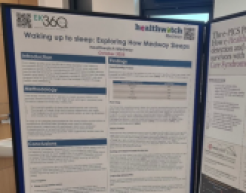
We were proud to showcase our recent project exploring Medway residents' sleeping habits and challenges at Kent University's Sleep Education event in November. Our academic-style poster was displayed to highlight key insights from local voices. 

It was a great opportunity to share what we've learned with healthcare professionals, medical students, and those with an interest in improving sleep health!

Kent & Medway Medical School are already planning to repeat the event, to ensure that more healthcare professionals can attend and learn from local research. Updates will be shared on their LinkedIn.

Go to the LinkedIn page
 

Social care

Health, Work and Wellbeing Collapse When Caring Hits 50 Hours

Between June and October 2025, Healthwatch Medway heard from 45 unpaid carers across Medway about the real impact of caring for a loved one.

The majority were providing over 50 hours of care each week, with 67% falling into this highest‑intensity group. Among carers reporting a decline in their physical health, 94% were providing 50+ hours of care. All carers who reported worsening mental health were also providing 50+ hours of care and living with the person they cared for. Caring responsibilities were also affecting employment, with 75% of high‑intensity carers not employed. Carers described exhaustion, isolation, strained relationships, reduced income and ongoing difficulty accessing timely support. The findings highlight a clear pattern: the more hours someone cares, the more their health, employment and wellbeing deteriorate. Read more in the full report.

Read the full report on hidden carers
 

Building a Neighbourhood Health approach

What’s important to Medway and Swale residents? 

In April we asked our Voice Connect panel, which consists of over 900 residents of Kent and Medway, what aspects of neighbourhood care would be most important to them. 

42% of people said ‘Service Accessibility’ was the factor that would have greatest influence in their perception of neighbourhood health. This was seen as better neighbourhood health equals shorter travel times, availability of local clinics, and integrated services. 

Public perceptions of service accessibility at a local level within the NHS show a mixed picture. We continue to hear from the public about the challenges in accessing GPs, waiting times for treatment pathways and growing concern about the levels of corridor care and A&E waiting times. The top priority for the public remains improving GP access. 


Wider determinants of health

Building a Fairer Medway: A Marmot Snapshot for Health Professionals

Medway’s new Marmot Insights report brings together 450 pieces of evidence from 90 organisations to show where the eight Marmot Principles need the greatest focus—especially early years support, fair employment, healthy living standards and stronger ill‑health prevention. 

The findings highlight persistent inequalities driven by cost‑of‑living pressures, limited access to services, and discrimination, underscoring the need for a whole‑system Marmot approach that strengthens prevention, improves data, and amplifies the voices of underserved communities as Medway works toward becoming a Marmot Place.

Read more about Medway becoming a Marmot Place
 
Why Residents Feel 'Medway Stops at Hoo'

In January 2026, Healthwatch Medway heard from 47 upper‑peninsula residents, with 55% raising concerns about healthcare access — and 94% of that feedback was negative. A lack of digital access was a major barrier, with 27% saying they can’t book or manage care because they don’t have a computer, an issue twice as common for residents aged 75–84.

GP access was also a challenge: 15% said travelling to Hoo surgery is difficult, especially for those with long‑term conditions. Beyond healthcare, 70% raised concerns about transport and road quality, and 30% said poor bus services limit their ability to shop, work or attend appointments. Overall, the findings show that distance, digital exclusion and poor transport combine to leave peninsula residents underserved.

Find out more
The full cost of running late

80% of Medway residents who spoke to us about buses shared negative feedback, saying unreliable services are directly limiting people’s ability to access school, work, and healthcare.

Medway residents told us buses are late, irregular, or don’t show up, leaving people stranded and missing key commitments. Young people reported being late for school despite planning ahead, while older residents and those with disabilities said poor services leave them feeling “stuck” and cut off from essential appointments.

Infrequent evening and Sunday buses mean many simply can’t get where they need to go, deepening isolation and widening inequality across the system.

Read our Medway transport spotlight report
 
Green spaces vs. overdevelopment - what we are hearing from Medway's Peninsula

In February 2026, Healthwatch Medway spoke to 29 lower‑peninsula residents, with 38% raising concerns about rapid building works — and all feedback on development was negative, citing loss of green space, rising traffic and growing pressure on GP access. Residents also highlighted the area’s natural assets, with 34% praising green spaces, though every negative comment pointed to environmental neglect.

17% said they would struggle to live locally without a car due to distance and limited transport. Community groups remain a key strength, with 48% describing strong social and practical support networks. Overall, residents want action on roads and traffic (31%) and better healthcare access (31%) as the population continues to grow.

 
Fear of ‘reasonable adjustments’
consequences in the workplace
 

It has been identified that Medway and Swale residents living with ADHD have avoided talking to their employers and seek workplace support.

People report that they often felt they couldn’t request reasonable adjustments without a formal diagnosis and they were fearful of negative consequences in the workplace.  

Read the report
The value of feeling connected 

In February, 2 in 5 residents of Swale said that they felt connected to their local community. Three quarters of these were retired older adults, who talked about the importance of community to help them access shops, and maintain social relationships and activities such as getting out for a meal. 

However, this same group of people also reported the greatest impact on their daily lives from unreliable bus services, but those in Sheppey were twice as likely to flag this as a problem, than residents living within Faversham. 

See more Insights
Older Swale adults feel safer than working age adults and young people  

In February 39% of the 46 residents of Swale we spoke to said that issues of crime and antisocial behaviour had a negative impact on how they felt about living in Swale. 

These issues were reported twice as frequently by working age adults (under 65yrs of age) and young people, than by older adults (over 65yrs of age).

People have talked about difficulties with groups of young people and of racially motivated intimidating behaviours. 

See more Insights
 
The startling gap in ethnicity and experience of general healthcare

In Medway and Swale, our data indicates that people who identify with mixed or multiple ethnicities are 75% more likely to report a negative experience of their general healthcare than other ethnicities. 

Medway is one of the most ethnically diverse areas in Kent, whilst Swale remains significantly less diverse than both Medway and the England average. These differences have important implications for service planning, healthcare experience, and inequality.

This pattern of feedback about the experience of healthcare within a distinct group of people from mixed and multiple ethnicities raises important equity issues as inequality in healthcare experience risks widening local health outcome gaps. There are locally initiated community-led, culturally responsive health initiatives, but these are not yet systemic. We would like to research these reported differences in experience to inform the work happening as a local level, enabling targeted action to address possible ethnicity-based differences in trust, access, and experience.

These issues were explored at the recent Kent and Medway Black Health Inequalities summit. Learning from peoples experience through the lens of intersectionality is vital to improving health equity locally. To be part of this research, please contact us at hello@ek360.co.uk.

Contact us here
 

Community/System News

Medway Therapeutic Alliance
The Medway Therapeutic Alliance provides short-term support for children and young people aged 5 to 18 (inclusive of 19th birthday). They also support those up to 25 for care leavers and those with Special Educational Needs and Disabilities.
The service offers a range of support;
  • Kooth – Free, confidential online support. Available 24/7, including moderated live chat and peer forums.
  • BfB Labs – Lumi Nova, a supportive game that helps children manage anxiety.
  • Young Lives Foundation – Peer mentoring to help build confidence, independence and resilience.
  • Salus – Evidence-based mentoring programmes supporting emotional wellbeing and coping skills.
  • North Kent Mind – different types of therapy and a Young Adult Support Service for care leavers.
  • Oasis – runs the "BeYou Project". This provides safe support for LGBTQIA+ children and young people.
  • Chums – Specialist traumatic bereavement support.
  • Barratt Behaviour Change Consultancy – Positive Behaviour Support, working closely with families.
The service also offers workshops and drop-ins for parents, carers and professionals.
To find out more information, including how to make a referral, take a look at our website.
Visit the website
 
Co‑produced videos on mental wellbeing

The Partnership Commissioning for Children and Families team at Medway Council has worked with students at MidKent College to co‑produce a series of short videos for children and young people with lived care experience.

The videos cover:

  • ‘What are you doing?’ – a positive, accessible video sharing practical ideas to support mental wellbeing and signposting to help when young people are feeling low
  • Panic attacks – an in‑depth exploration of what panic attacks are and techniques to help manage them
  • Asthma – a powerful narrative focusing on the risks of undiagnosed or poorly controlled asthma, addressing a serious issue affecting CYP nationally

All videos can be viewed on the Medway Local Offer for Care Leavers

Watch the videos
 
Add your voice to the hundreds of voices that talk to us each month
Voices Connect

Every month we ask the hundreds of voices that make up our Voices Connect panel one question.

Questions that we ask can be about anything that might affect someone's health, social care or community.

These Insights add depth to our reflections and bring richness to our reports. When you answer the monthly question you are helping to paint a wider picture of how people are feeling across Kent and Medway.

Want to add your voice to the hundreds of others already having the conversation? Email us at voices.connect@ek360.co.uk.

For more information about any of the contents of this Insight Update, please email us at comms@ek360.co.uk.